


A jersey is an easy gift to choose and surprisingly difficult to wrap. It’s large, soft, and slippery; the paper pulls tight at the corners, and the package often ends up as a floppy ball that won’t stay under the tree. Worse still: a crease right across the number, tape stuck directly to the fabric, or a box that’s too small and crushes the lettering for three weeks.
The good news is that it all comes down to three decisions: how to fold it, the container, and what to place between the layers. Allow ten minutes, no more. Here’s the complete method, from folding to protect the lettering to mailing it, along with the mistakes that can damage a new jersey before it’s even worn.
Turn the jersey inside out, fold back the sleeves, create two vertical panels, then fold horizontally below the lettering. Place a sheet of tissue paper over the number, lay everything flat in a shallow box that fits, then wrap the box, not the garment.
Add the card, gift receipt, and, if you’re unsure about the size, the measurements of the style you chose. A successful gift is judged by the moment it’s opened, not by how much ribbon you use.
What to prepare before you start
Wrapping clothing is nothing like wrapping a book. A jersey has no structure: if you place it directly on the wrapping paper, the corners cave in and the package loses its shape as soon as you pick it up. The solution comes down to a principle used in every folding workshop: first give the garment a shape, enclose it in a flat container, then wrap the container.
You won’t need much. A shallow box, tissue paper, matte wrapping paper, fabric ribbon, and a gift tag are enough for a result that’s far better than the store’s plastic bag. Avoid thin metallic paper, which tears at the corners, and choose fabric ribbon over plastic curling ribbon, which is harder to tie neatly around a large box.
- 1Wash your hands and work on a clear table: a clean surface prevents greasy marks on a light-colored jersey.
- 2Remove the price tag if it can be detached, but keep the size label sewn into the collar.
- 3Prepare the card and gift receipt before closing the box, or you’ll have to open it all over again.
- 4Cut the wrapping paper to fit the box, not the garment: you’ll have much less bulk at the corners.
Fold a jersey without marking the flocking
The flocking is the most delicate part of the gift. The letters and numbers are heat-applied or made of flex film, and they don’t fare well with sharp folds or weeks of compression. A jersey folded number against number can come out with a shiny mark or a slightly lifted corner. The method below avoids direct contact and creates a neat rectangle that fits easily in a box.
Lay the jersey face down, with the back facing you, and smooth out the creases with your hand. Working on the reverse protects the printed sponsors and number throughout the process.
Bring each sleeve toward the center in a straight line from the shoulder. The sleeves shouldn’t overlap in the middle of the back, where the lettering is.
Fold both sides of the jersey inward by equal amounts to make a strip the width of your box. Keep the side seams parallel.
Slide a sheet of tissue paper where the horizontal fold will fall. It keeps the flocking from pressing against itself.
Fold it in half, aiming for an unprinted area above or below the number. One fold is better than three tight folds that leave visible lines on opening day.
If the box is smaller than the folded jersey, don’t add another fold: use a different box. An extra fold stays creased in the polyester for several days, especially on retro jerseys with a thick knit.
Three wrapping methods, depending on the result you want
There’s no single right way to do it. A gift handed over in person, a parcel sent across the country, and a surprise placed under the tree each come with different constraints. Compare the three approaches below, then choose the one that suits your situation and how much time you have.
For: any situation, and essential if the gift will be waiting for several weeks.
Lay the folded jersey flat in a shallow box, surrounded by tissue paper. Then wrap the box, creating crisp corners and a firm surface for the ribbon. This is the only method that really protects the printed name and number from pressure and rubbing.
- Time: five minutes once you’ve found a box.
- Advantage: the package stands upright and can be carried without losing its shape.
- Tip: slipping a piece of cardboard under the jersey makes the box even sturdier.
For: a quick handover on the same day, with no box to hand.
First wrap the folded jersey in tissue paper, then in thick kraft paper, securing it with discreet tape on the paper itself. The result is soft, deliberate, and very handcrafted. However, it offers little protection: avoid this method if the package has to travel at the bottom of a bag.
- Time: three minutes.
- Advantage: no need to buy anything; kraft paper and string are all you need.
- Limitation: the corners will never be perfectly crisp on a textile.
For: a gift you want to make spectacular to open.
Roll the jersey loosely, with the printed name and number facing outward but protected by tissue paper, then place it in a deeper box so the number is visible as soon as the lid is lifted. You can add a card with the recipient’s name, like a locker-room presentation.
- Time: ten minutes.
- Advantage: the effect when it’s opened is unbeatable.
- Careful: never roll it tightly; the circular fold will leave a mark in the knit fabric.
Match the wrapping paper to the jersey’s colors
A well-wrapped package hints at the gift without giving it away. L’The idea isn’t to replicate the team’s colors, but to let the jersey take center stage when it’s opened. Plain, matte paper in a neutral shade brings out any jersey. The combinations below work in the vast majority of cases.
One final detail matters more than the pattern: the quantity. Two colors are enough. If you add printed paper, a glitter ribbon, and three labels, the package gets busy and the thought gets lost. Stick to one unique touch, such as a handwritten tag with the number the person likes to wear.
If the gift is being sent by mail
A parcel can be stacked, sorted in bins, and sometimes exposed to moisture. Gift wrap alone is never enough: it arrives crumpled, torn at the corners, and the ribbon gets caught in the machines. The rule is simple: wrap it twice. The gift-wrapped package goes inside, and a shipping container goes outside.
| Container | What it protects | What to watch out for |
|---|---|---|
| Padded envelope | A jersey on its own, folded in a resealable bag | The gift package often arrives crushed: use this for a jersey on its own |
| Flat cardboard box | The complete gift package, including the box | Fill empty spaces with paper to prevent the contents from shifting |
| Double-wall cardboard box | A jersey, shorts, and socks set | Greater weight and volume, so higher shipping costs |
| Plastic bag only | Nothing sturdy | Avoid: it lets impacts through and traps moisture |
Slide a sheet of paper between the garment and the cardboard to prevent creases, and seal the inner bag without excess air. N’t write the contents on the outside of the parcel. If the gift needs to arrive by a specific date, allow a few extra days in December: that’s when delivery times are most likely to increase.
Finishing touches that make a difference when opening the gift
It takes just a few small touches to turn a decent package into a real gift. First, the card. Writing the name and number the person would wear on their back is better than a generic message. Then, the gift receipt, tucked into a sealed envelope rather than placed on the jersey: it’s less visible, yet it takes care of the size question.
If you’re giving a customizable jersey, you can also let the recipient choose the name and number print and include a note explaining it. To avoid an exchange, compare the measurements before buying: the charts in our football size guide give the chest width and length of each cut, which is much more reliable than guessing between M and L.
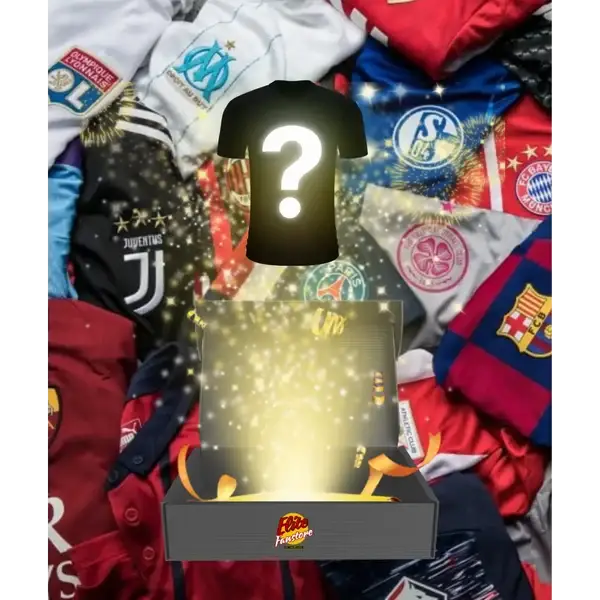
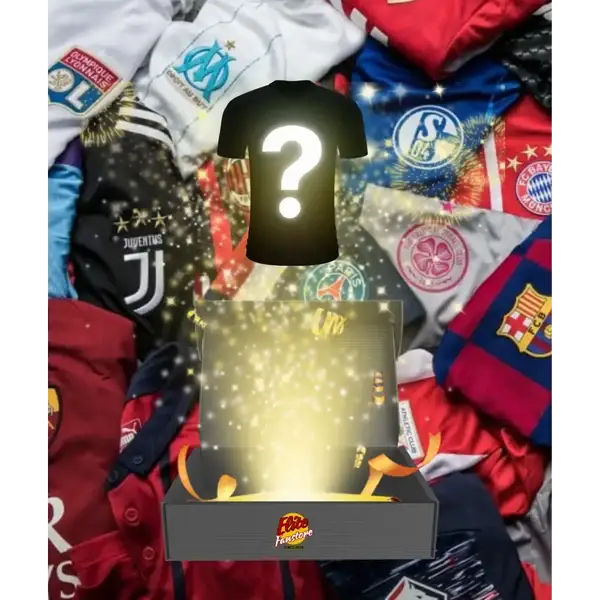
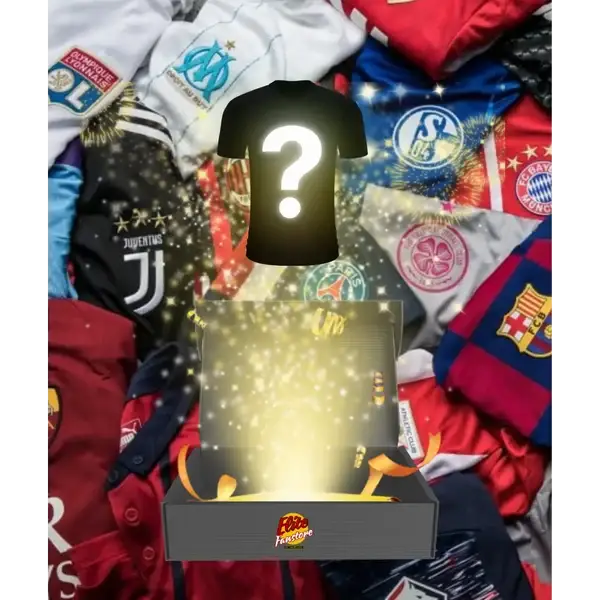
And if the person already owns half the products from their club, the element of surprise becomes more important than the model itself. That's the whole point of mystery boxes, which turn opening the gift into a game.
Three gift ideas ready to wrap, available in the store.
Mistakes that damage a new jersey
A jersey can deteriorate between purchase and unwrapping without ever having been worn. The causes are almost always the same, and come from well-intentioned gestures: wanting a tightly wrapped package, wanting it to smell nice, wanting to have it ready two months in advance.
Never stick adhesive tape directly onto the fabric or the lettering, not even masking tape. When peeled off, it can sometimes take a thin layer of the print with it or leave behind residue that can no longer be removed cleanly.
- An airtight plastic bag for weeks. The fabric can no longer breathe and may retain a musty smell, especially in a damp room.
- Spraying perfume on the package. L’alcohol can stain light-colored polyester, and the mark remains visible after washing.
- Tape that's too tight. On a soft box, it leaves a sunken line that runs across the width of the jersey.
- Iron right before wrapping. The heat softens the heat-applied logos, and the crease you make afterward sets much more permanently.
- Storing it near a radiator or behind a window. Heat and direct sunlight can dull bright colors in just a few weeks.
If you’re preparing the gift ahead of time, store it flat in a room with a moderate temperature and take it out of its bag at least the day before. And if you’re still looking for the right style, our guide to choosing the right jersey for the fan will help you avoid the classic duplicate: a home jersey that’s already in the closet.
Frequently asked questions
No. A new jersey should be given as is, with its tags on. Washing it before gifting takes away its fresh-from-the-factory look and means you have to iron it, which isn’t good for the lettering.
Wrap it in tissue paper, then in thick kraft paper secured with a ribbon. To make the package more rigid, slip a piece of cardboard the size of the folded jersey between the tissue paper and the outer wrapping.
Yes, and it often makes the most memorable gift. Just check the size before having the lettering applied, since a personalized jersey can’t be exchanged as easily as a standard one.
A box measuring about 35 x 25 cm and 5 cm high will fit an adult jersey folded into two sections. For a set with shorts and socks, choose one that’s 8 or 10 cm high rather than compressing the contents.
Two to three weeks without any problems, as long as the package stays flat, dry and out of the light. If you’re preparing it earlier, get the box ready but add the jersey at the last minute to prevent creases from setting in.
A package that protects the garment
Wrapping a jersey is mainly about protecting it from three enemies: sharp creases, prolonged pressure and heat. Folding it inside out, placing a sheet of tissue paper over the lettering and using a box that’s the right size takes care of all three at once, for a neat result and an undamaged garment.
The rest is a matter of taste. Plain wrapping paper, a fabric ribbon, a handwritten card and a gift receipt tucked into an envelope are more than enough. When the day comes, what people remember isn’t the number of layers of paper, but the moment the colors finally appear.