


The mini kit has become the most requested football gift for children, and also the one people get wrong most often. The reason is simple: it includes three garments that are sized differently. The jersey and shorts use numbered sizes from 16 to 28, socks are chosen by shoe size, and the age shown is only ever an average.
A familiar outcome: an outfit ordered in “age 8” arrives too short because the child is already 1.45 m tall, or the socks slip because the shoe-size range doesn’t fit. Here’s how to read mini kit sizes, which measurement to prioritize, and how to decide when your child falls between two size ranges.
Choose the mini kit size based on the child’s height in centimeters, not their age. Size 16 corresponds to 95 to 105 cm, size 20 to 115 to 125 cm, size 24 to 135 to 145 cm, and size 28 to 155 to 165 cm.
Socks come in just two sizes: 24-36 for children up to about 13 years old, and 39-46 for teenagers and adults. If you’re between two kit sizes, choose the larger one.
What a mini kit actually includes
The word “kit” can refer to two different things. The most common is a matching jersey and shorts in the colors of an official uniform. The second also includes a pair of long socks, giving you the complete Sunday morning outfit. Before buying, check the product description to see what’s included, as that’s often why the prices differ.
One detail matters for the little ones: some outfits for babies are available as bodysuits, with a snap closure at the crotch. They don’t follow the same sizing chart as junior kits. For everything related to choosing the style, club and name and number printing, our complete guide to children’s football jerseys goes beyond this page, which focuses on measurements.
The children’s size chart, line by line
The first thing to understand: the number shown on the label is neither the child’s age nor a standard French size. It’s a technical size that corresponds to a height. Size 24 doesn’t mean “24 months” but “about 135 to 145 cm,” or an average 8- or 9-year-old. This is the number one source of confusion when ordering.
| Approximate age | Size | Top length | Shorts length | Recommended height |
|---|---|---|---|---|
| 2 to 3 years | 16 | 43 to 45 cm | 31 to 33 cm | 95 to 105 cm |
| 3 to 4 years | 18 | 46 to 48 cm | 33 to 35 cm | 105 to 115 cm |
| 4 to 5 years | 20 | 49 to 51 cm | 35 to 37 cm | 115 to 125 cm |
| 6 to 7 years | 22 | 52 to 54 cm | 37 to 39 cm | 125 to 135 cm |
| 8 to 9 years | 24 | 55 to 57 cm | 38 to 40 cm | 135 to 145 cm |
| 10 to 11 years | 26 | 58 to 60 cm | 39 to 41 cm | 145 to 155 cm |
| 12 to 13 years | 28 | 61 to 63 cm | 42 to 44 cm | 155 to 165 cm |
Measure the top from the top of the shoulder to the bottom of the garment, laid flat. This is the most useful measurement for comparing it with a jersey the child already wears and that fits well. Measure the jersey on a table without stretching it, then look for the closest match in the chart.
You’ll notice that the size chart goes from 4-5 years to 6-7 years, with no in-between row. So for a five-and-a-half-year-old, age alone doesn’t settle the question: only their height can help you choose between size 20 and size 22. The official chart is always available on the store’s children's size guide page.
Find the right size in one click
Measure the child barefoot, standing with their back against a wall, and select the corresponding range. The result shows the size to order as well as the expected jersey length, so you can compare it with a garment already in the wardrobe.
Top length: 43 to 45 cm, shorts: 31 to 33 cm. Recommended age: 2 to 3 years. Size 24-36 socks if their shoe size fits.
Top length: 46 to 48 cm, shorts: 33 to 35 cm. Recommended age: 3 to 4 years. Remember to check head circumference to make sure the collar will fit over the head.
Top length: 49 to 51 cm, shorts: 35 to 37 cm. Recommended age: 4 to 5 years. This is the in-between size compared with size 22 at the end of the school year.
Top length: 52 to 54 cm, shorts: 37 to 39 cm. Recommended age: 6 to 7 years. The most popular size for a first club registration.
Top length: 55 to 57 cm, shorts: 38 to 40 cm. Recommended age: 8 to 9 years. Size 24-36 socks will still fit comfortably.
Top length: 58 to 60 cm, shorts: 39 to 41 cm. Recommended age: 10 to 11 years. Keep an eye on shoe size, which is often close to 37.
Top length: 61 to 63 cm, shorts: 42 to 44 cm. Recommended age: 12 to 13 years. For older children, check adult sizes S.
Select a range above to display the corresponding size.
No tape measure handy? Stand the child against a wall, mark the top of their head with a pencil, then measure using an A4 sheet of paper: it is exactly 29.7 cm long. Three and a half sheets correspond to approximately 104 cm.
Socks: just two sizes
They’re the simplest part of the kit, yet they cause the most surprises. Football socks are knitted from a very stretchy fabric, so the catalog offers just two shoe size ranges. Each covers a very wide range, which is normal for this type of product.
| Size | Shoe size | Approximate age | Foot length | Height |
|---|---|---|---|---|
| 24-36 | 24 to 36 | Approximately 4 to 13 years | 15 to 23 cm | 30 to 40 cm |
| 39-46 | 39 to 46 | Teenagers and adults | 24 to 30 cm | 42 to 52 cm |
For shoe sizes 37 and 38, which aren’t included in either range, choose 39-46: the knit tightens with wear, and the foot stays in place better than in socks that are too short. Measure the height from the heel to the top edge, with the sock flat and not stretched. It should cover the shin guard without extending ten centimeters beyond it.
Socks that are too big bunch up inside the shoe and cause chafing. Socks that are too small slip under the heel by half-time. Either way, if the child keeps pulling their socks up every five minutes, that’s the best sign they’re the wrong size.
Should you go up a size?
It’s every parent’s instinct, and often for good reason. A child can grow five to seven centimeters in a year, and a kit bought in September should ideally last until the following summer. A sensible rule of thumb: if the child is near the top of a height range, go up a size. If they’re near the bottom, stick with their usual size.
Just be careful not to go up two sizes. A difference of ten centimeters in length turns the shirt into a dress, and the shorts won’t stay up, even when tightened all the way. Getting two seasons’ worth of growth in one go means losing a season.
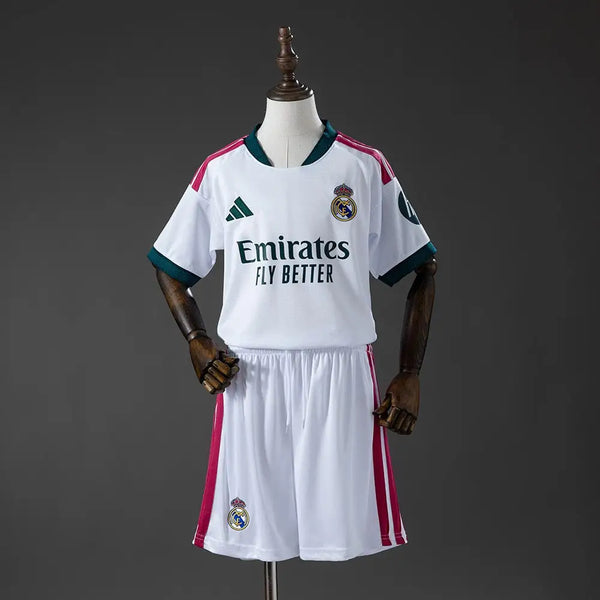
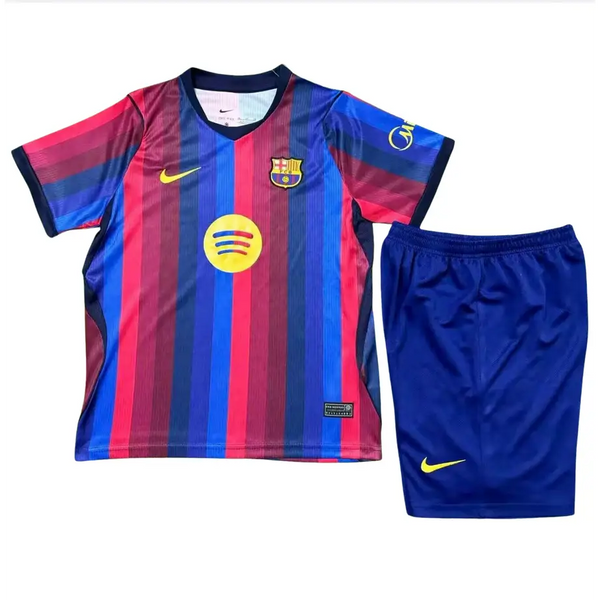
Three complete kits available in the store, with matching shirt and shorts.

Printing, number and kit care
On a children’s kit, the name and number printing goes on the jersey, and sometimes on the shorts for the number. Choose a number the child really likes rather than one belonging to a player who might leave in the next transfer window: the child’s name is the safest choice, and it’s also the most popular option on kits for under-tens.
For care, wash the kit at 30 degrees, with the jersey and shorts inside out, and without fabric softener. Put the socks in a mesh bag to stop them wrapping around the drum. Air-dry them: tumble-drying shrinks the socks’ knit and hardens the heat-pressed lettering adhesive, making the number look old far sooner than Saturday’s matches.
A child’s kit often comes back covered in mud, and it’s tempting to use the 60-degree wash cycle. That’s exactly what makes the lettering peel and the colors fade. Soak it in cold water, then wash as usual at 30 degrees.
Frequently asked questions
On average, for children aged 8 or 9 who are 135 to 145 cm tall. Age is only a guide: a 7-year-old who is 138 cm tall should also choose size 24.
Yes, in a mini kit the shorts match the jersey size. Their elastic waistband accommodates some differences in body shape, making them the most forgiving piece in the set.
Choose size 39-46. Shoe sizes 37 and 38 aren’t covered by either range, and the stretchy knit holds the foot better than a size 24-36 sock pushed to its limit.
Yes, and it can sometimes be useful when the child’s upper body and legs are different sizes. Just make sure both pieces belong to the same outfit; otherwise, the shades of color may differ slightly.
Above 165 cm, size 28 becomes too short, and adult size S is the next step. Compare the top length: 61 to 63 cm in size 28, versus 69 to 71 cm for an adult S in supporter fit.
The right thing to do before ordering
Choosing a mini kit takes two minutes if you have the right information: the child’s height. The rest follows from the chart: the shorts match the jersey size, and the socks are chosen by shoe size. Buying based on age alone is what lands kits at the back of the closet.
One last tip before checking out: measure a garment the child already wears and compare the length. It’s the most reliable method, and it avoids the hassle of returning it by mail, especially when the gift was expected for a birthday or the first practice of the season.