


It’s one of the most frequently asked questions about the world’s most popular sport, and there’s no single answer. No one invented football in the sense of inventing a machine. However, one precise date marks the birth of football as we know it: October 26, 1863, in London, when a handful of clubs finally decided to write down common rules.
Before this meeting, ball games had existed for more than two thousand years, from ancient China to French villages in the Middle Ages. After it, football took its modern form, split from rugby, crossed the Channel, and then spread around the world. Here is the full story, from its distant origins to the first competitions, and what this changed for players’ clothing.
Modern football was created on October 26, 1863, in London, with the founding of the Football Association. Eleven clubs and schools met to adopt common rules, and Ebenezer Cobb Morley, the federation’s first secretary, drafted the first laws of the game.
No single person invented football. Ball games existed long before, including Chinese cuju, which FIFA recognizes as the oldest documented form of the game.
October 26, 1863: the true birth date
That evening, representatives of London clubs and schools gathered at a tavern on Great Queen Street in London. Their problem was simple and very practical: each institution played by its own rules, making matches impossible to organize. Some allowed players to pick up the ball; others did not. Some tolerated kicking opponents in the shins; others prohibited it.
The Football Association was born from this meeting, becoming the first federation in the history of sport. In the weeks that followed, it adopted its first set of rules, the Laws of the Game. Ebenezer Cobb Morley, a lawyer and player, was the main drafter and became the federation’s first secretary. He is most often credited with being the administrative father of football.
The word itself dates from this period. “Association football” was shortened to “soccer” in Oxford student slang, while “football” remained the common term in most countries. Both words refer to exactly the same sport, born at the same meeting.
Before 1863: two thousand years of ball games
Football didn’t come out of nowhere. Almost every civilization invented a game involving moving a ball with the feet, often in a military, religious, or festive setting. FIFA officially recognizes one of them as the oldest form: Chinese cuju, played during the Han dynasty, in which players had to kick a leather ball through an opening without using their hands.
In Europe, the Middle Ages gave rise to much more brutal versions. In France, soule pitted entire villages against each other across fields, sometimes over several kilometers, with very few rules. In Italy, Florentine calcio codified a spectacular ball game in the 16th century, played by teams of twenty-seven, which is still reenacted in Florence today.
These games have one thing in common: they’re played differently from one village to another, and nobody is trying to standardize them. That’s exactly what would change in 19th-century England.
Why it all happened in England
At the beginning of the 19th century, each of England’s great schools played its own version of football. The pitches differed, as did the number of players, and the rules were passed down orally. The problem arose when these pupils went to university: gathered at Cambridge or Oxford, they could no longer play together because there was no shared code.
As early as 1848, a group of Cambridge students tried to draft a unified set of rules, the famous Cambridge Rules. This text would serve as a basis for discussion fifteen years later, when the Football Association was founded. At the same time, in Sheffield, a club founded in 1857 developed its own rules and organized the first regular matches between established teams.
England therefore brought together three conditions rarely found elsewhere: schools where the game was played intensively, rapid urbanization that created working-class clubs, and a tradition of organizing into associations. Modern football was not born in England by chance, but because it was the only place where a federation could emerge so quickly.
The split from rugby
The 1863 discussions came to a head over two points: the right to run with the ball in hand, and hacking, meaning deliberately kicking an opponent’s shins. Some clubs wanted to keep these practices, while others wanted to ban them to make the game more skillful and less dangerous.
Blackheath, a club that supported handling the ball, left the Football Association a few weeks after its founding. This departure marked the definitive split between two sports that had until then shared the same name. It was not until 1871 that supporters of handling the ball founded their own federation, giving rise to rugby as we know it.
This split explains many differences that persist today, from the round ball versus the oval ball to the jerseys. Rugby kits remained more durable and tighter-fitting because the game allows players to tackle opponents, while football was able to adopt lighter clothing.
A timeline of firsts
Once the rules were written, everything moved very quickly. In less than thirty years, football had a national cup, international matches, professionalism, and a league. Here are the key milestones.
Sheffield FC is founded. It is now recognized as the oldest football club still in operation in the world.
The Football Association is established and the first Laws of the Game are written on October 26 in London.
The FA Cup is launched, the oldest football competition still played today.
Scotland and England face off in Glasgow in the first official match between two national teams.
The English federation allows players to be paid, after years of tensions with clubs in the north.
The Football League is founded, becoming the model for all the national leagues that follow.
Seven European football associations found the Fédération Internationale de Football Association in Paris.
Uruguay hosts and wins the tournament's first edition, sixty-seven years after the London meeting.
So what about the football shirt?
When the Football Association was founded, players did not wear kits in the modern sense. They played in thick wool shirts, often with stiff collars, sometimes wearing a cap or hat to distinguish the teams. Colors were not yet used to identify a club, but simply to tell the two groups of players apart on a muddy pitch.
Standardization comes with competitions. Once teams travel and spectators pay to enter, colors need to be consistent and recognizable, and the two sides need distinct kits. This is the direct origin of home and away kits. Numbers would not appear until the 20th century, and players' names even later.
Wool gradually gives way to cotton, then to synthetic fibers in the 1970s and 1980s. Garments become lighter, collars evolve, and advertising makes its debut: a turning point we explore in detail in our article on the arrival of sponsors on football shirts.
Three reissues of England kits, from the country where modern football was born.

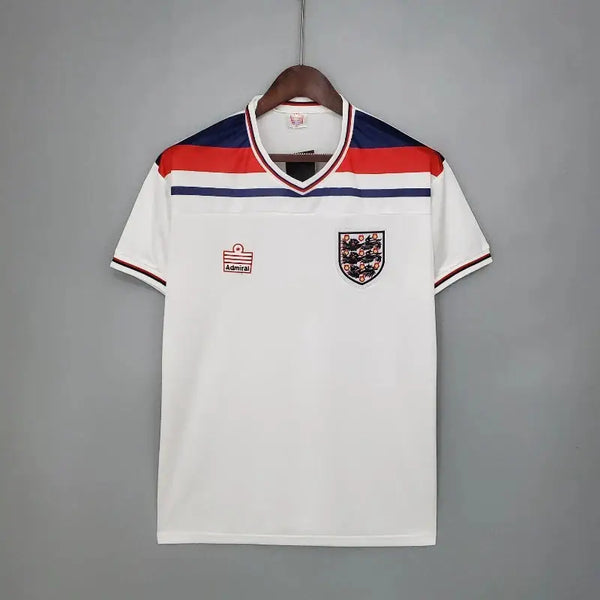

These reissues are among the vintage styles available in the store, alongside many club kits from past decades.
Frequently asked questions
In 1863, with the founding of the Football Association in London on October 26 and the drafting of the first laws of the game. This is the official birth date of modern football.
No one person. Modern football is the collective work of the clubs that came together in 1863, and especially of Ebenezer Cobb Morley, who drafted the first laws and became the first secretary of the English association.
Sheffield FC, founded in England in 1857, is recognized as the oldest football club still in operation. It predates the founding of the English association by six years.
The word comes from the slang abbreviation of association football, used by 19th-century English students. It has remained in use in countries where another sport is already called football.
By the end of 1863, when supporters of handling the ball left the Football Association. They founded their own union in 1871, giving rise to modern rugby.
A collective invention, a specific date
If someone asks you who created football, the honest answer comes in two parts. Ball games are universal and ancient, played on every continent long before the 19th century. Football, however, was born from an administrative decision made in London on October 26, 1863, when eleven clubs agreed to play by the same rules.
Everything else follows from that: the competitions, national teams, leagues, and even the colors worn by the players. That evening, no one imagined that a few pages of rules would give rise to the most-watched sport on the planet.