


A jersey can look magnificent on its own and create an unbalanced outfit as soon as shorts are added. Conversely, an outfit whose three pieces seem ordinary separately can become very strong once worn. The difference rarely comes from buying the exact official kit. It comes from a simpler rule: give the jersey, shorts, and socks different roles, then check that their colors, volumes, and use tell the same story.
This guide starts with the jersey everyone already owns, whether home, away, or third, and builds the rest around it. It explains why official shorts are not always the same color, how to choose your size without assuming it should be identical to the top's, what high-top, non-slip socks are really for, and how to simplify the outfit for a child or for training.
A successful outfit reads from top to bottom
The jersey carries the identity: crest, sponsor, stripes, pattern, and possibly lettering. The shorts stabilize that identity. The socks complete the silhouette and can either extend the shorts' color or echo a secondary shade from the top. If all three pieces try to attract attention at the same level, the outfit looks cluttered. If one leads and the other two respond, the whole looks intentional.
This hierarchy explains why mixing seasons can work. Neutral black, white, or navy shorts go with many jerseys. By contrast, very graphic shorts covered with a large side pattern call for a much calmer top. So always start by counting the jersey's dominant colors. Beyond three, do not try to include them all.
Home, away, third: three different strategies
Echo the historic color with classic contrasting shorts. The socks can match either the jersey or the shorts.
Keep the palette lighter or reverse the home colors. Avoid adding a fourth shade that is not present on the top.
The experimental jersey leads. Calm it with solid shorts in its darkest color and simple socks.
The three-color method
First identify the dominant color, the one that covers more than half of the jersey. Then identify the structural color, found on the collar, shoulders, stripes, or large panels, followed by the accent, often present on a trim, crest, or lettering. The shorts should use the dominant or structural color. The socks can repeat either of the two, while the accent should remain a detail.
| Jersey | Recommended shorts | Socks | Result |
|---|---|---|---|
| Red with white sleeves | White for a classic look, red for a block of color | Red or white | Strong, highly recognizable identity |
| Navy blue with yellow accents | Navy | Navy with yellow accents | Long, cohesive silhouette |
| Almost solid white | White for elegance, dark for contrast | The same color family as the shorts | Minimal or highly graphic |
| Vertical stripes | A solid color taken from the stripes | The second color or the color of the shorts | The pattern remains concentrated on the top |
| Multicolored third kit | The darkest shade of the jersey | Solid, without any additional pattern | The top remains the main piece |
| Very loose retro fit | Short or straight shorts, without extra bulk | Classic high socks | Period-accurate proportions |
Why are the official shorts not always the same color as the jersey?
Because a match kit should read as a complete outfit, not as a monochrome combination. A red jersey with white shorts creates a clear boundary between the torso and legs and can reflect a historic club color scheme. The contrast also makes it easier to distinguish between two teams when their tops are similar or broadcast conditions reduce the differences in shade.
There are variations. A club may wear shorts in a different color away from home while keeping the same jersey, simply to avoid confusion with the opponent. Photos from a single match therefore do not prove that the combination was the official kit for the entire season. To reproduce a kit exactly, check several matches rather than just the shop or launch photo.
You do not need shorts from the same season. Shorts without a large pattern, in a color already present on the jersey, almost always produce a cleaner result than an “almost matching” model whose shade clashes slightly.
Shorts size and jersey size: do not automatically copy the letter
Wearing an M in a jersey does not mean that an M in shorts will be ideal. Choose the top based first on chest width and torso length. The bottom depends on your waist, hips, thigh circumference, and the fit you want. Two people wearing the same jersey may need different shorts, and that is perfectly normal.
The elastic waistband provides some flexibility, but it does not fix everything. If the shorts are too large, the drawstring has to be tightened excessively, creating thick folds under the jersey. If they are too small, they ride up with every run, compress the thigh, and can restrict your range of motion. When hesitating between two sizes, compare a flat measurement with a pair of sports shorts that fits you: unstretched waistband width, side length, and leg opening.
Player version, replica, and retro: pay attention to proportions
A player version jersey is often more fitted than the corresponding supporter shorts. You can therefore choose the top one size larger while keeping your usual size on the bottom. Conversely, a very loose retro jersey does not pair well with long, wide shorts: the silhouette loses its lines. Pair it with shorter, straight-cut shorts or partially tuck in the top.
For city wear, the priorities are different. Seated comfort and pocket depth matter more than aerodynamics. Match shorts without pockets are true to the field, but less practical for carrying your phone and keys. Check this detail before buying a set intended mainly to be worn outside the stadium.
Knee-high socks, grip socks, and shin guards
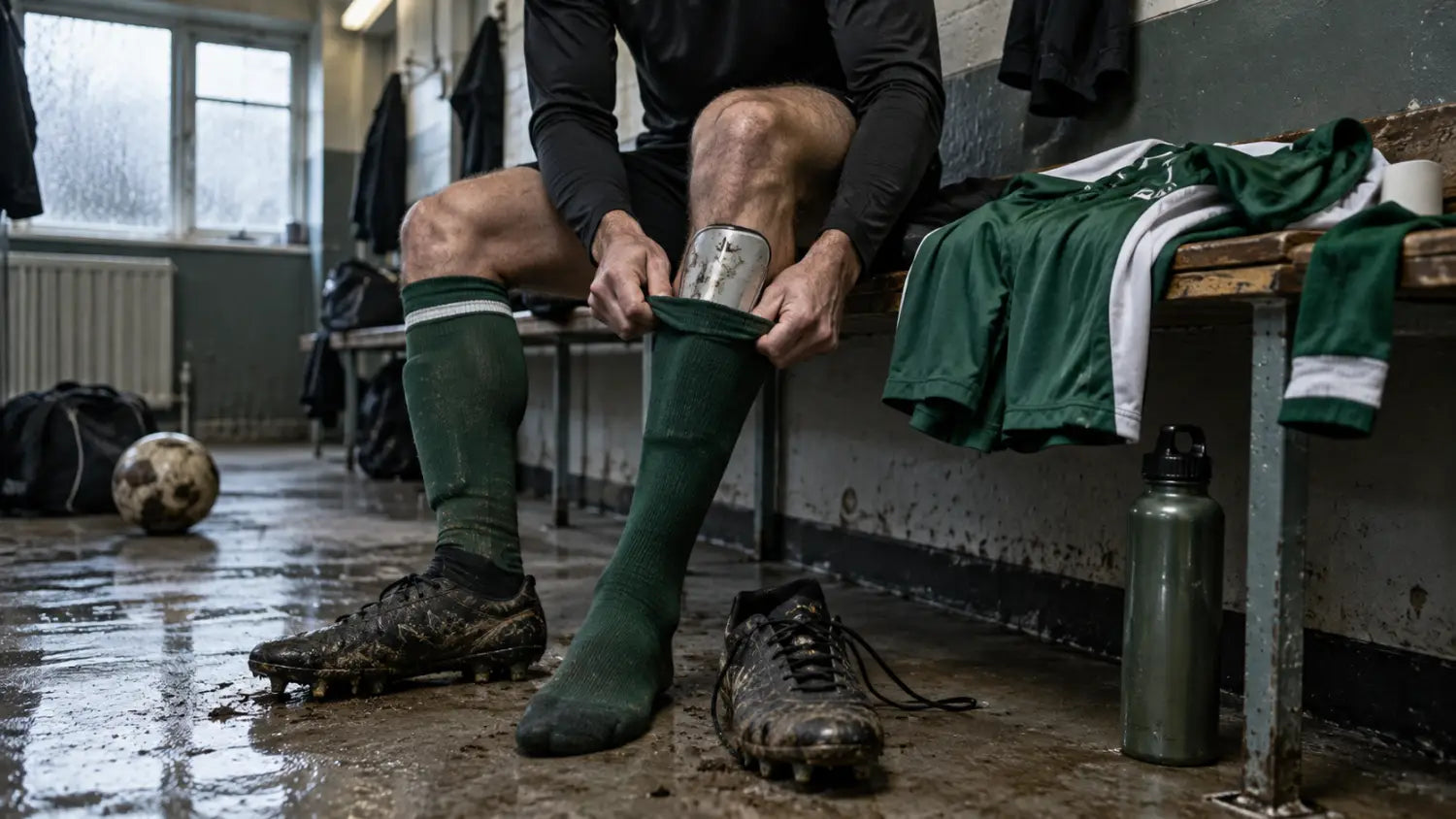
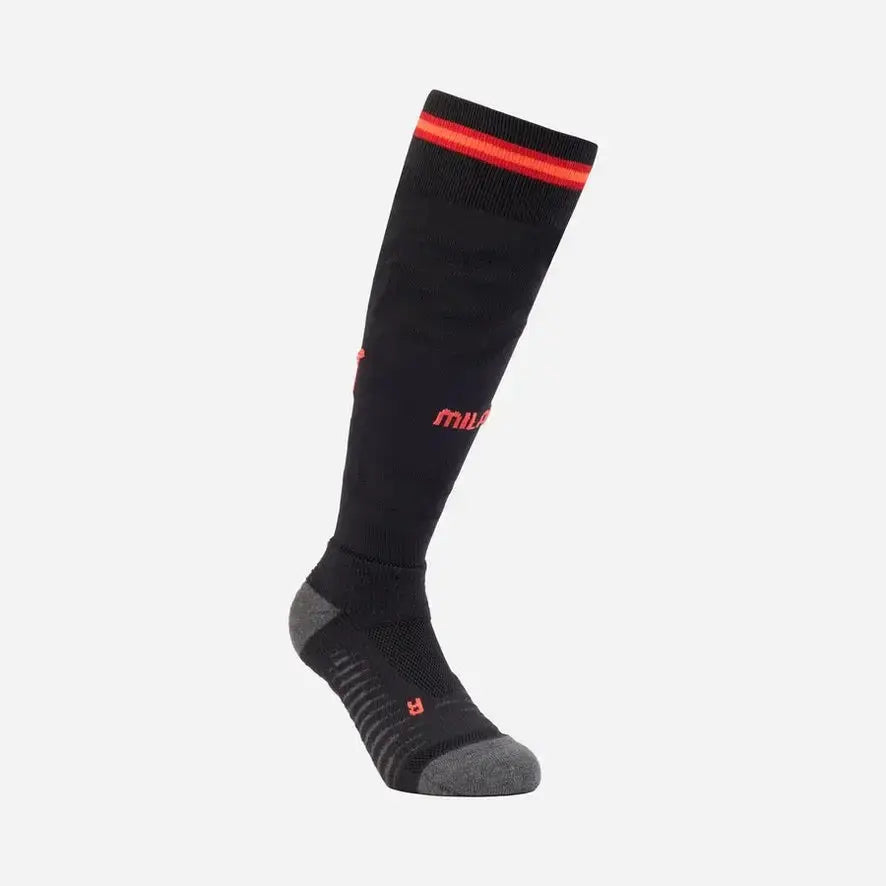
A football sock is not an ordinary sock extended up to the knee. It must cover the shin guards, stay in place during changes of direction, and limit areas of friction inside the shoe. Its choice therefore depends more on how it will be used than on its color.
Non-slip socks do not magically make you faster. Their purpose is to reduce foot movement inside the shoe, which can improve the precision of your footwork and limit certain hot spots. However, a model that is too thick in an already-tight cleat increases pressure, compresses the toes, and can produce exactly the opposite of the comfort you are seeking.
If you play competitively, the adhesive tape or any material worn on the outside must be the same color as the part of the sock it covers. The sleeve and the grip sock must not create an unauthorized contrasting band. When in doubt, choose tape and the visible part of the grip sock in the dominant color of the match sock.
For a child: simplicity, growth, and independence
For a child, the best kit is not the one that most faithfully reproduces the first team’s photo. It is the one they can put on by themselves, that stays in place, and that withstands frequent washing. A coordinated children’s kit solves many problems at once: colors that already match, consistent proportions, and sizes designed to work together.
Do not size up excessively “for two years.” A slightly loose jersey remains wearable; shorts whose waistband drops despite the drawstring hinder running, and socks that are too long form folds behind the knee. A reasonable allowance is enough room to slip a thin layer under the top and adjust the waistband without a bundle of fabric.
Ask the child to raise their arms, squat, run in place, and pull their socks up by themselves. If their stomach is fully exposed, the shorts slip down, or the fold in the sock bothers the knee, the size is not right, even if the label matches their age.
For the field, put the name on a small inner label rather than adding multiple visible markings. And pack a second pair of socks: they are the item that stays damp the longest and the one most easily forgotten at the bottom of the bag.
The training kit is not a second-rate match kit
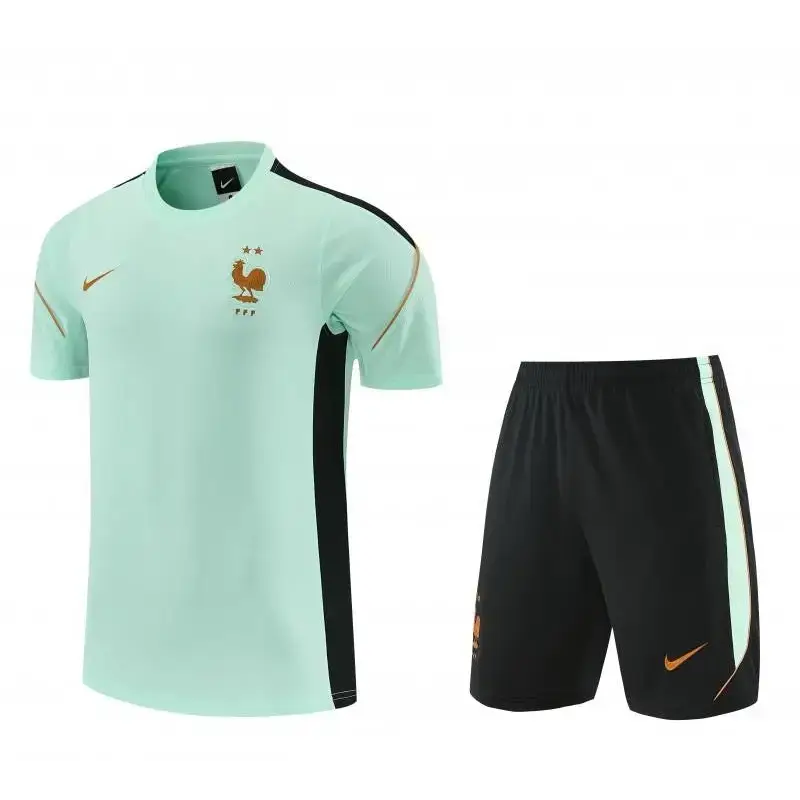
The match kit prioritizes identity and lightness. The training kit must withstand repetition: several sessions per week, contact with the ground, frequent washing, and temperature changes. A technical T-shirt or more understated training top, paired with sturdy shorts and socks that are easy to replace, is often more practical than the main jersey.
For an intense session, avoid cotton under the jersey: it absorbs moisture, becomes heavier, and cools you down as soon as the effort decreases. Prefer a thin synthetic layer if the temperature requires it. Keep the tracksuit for the warm-up, waiting periods, and cooldown, then remove it during the most intense part if you start to overheat.
The kit can also be a simple solution for a child: coordinated top and shorts that you do not mind getting dirty, a pair of neutral socks, and a lightweight jacket in the bag. The goal is not to replicate every item worn by professionals, but to eliminate unnecessary decisions before each session.
If you are playing an official match, aesthetics come after the regulations
The Laws of the Game define five separate mandatory elements: a jersey with sleeves, shorts, socks, shin guards, and boots. Shin guards must be covered by the socks. Both teams must wear colors that distinguish them from each other and the referees, while the goalkeeper must be distinguishable from everyone.
| Element | Requirement | Common mistake | Solution |
|---|---|---|---|
| Jersey | With sleeves, team colors | Base layer in a different color | Same main color as the sleeves |
| Shorts | Separate element | Visible contrasting compression shorts | Same color as the shorts or their lower section |
| Socks | Cover the shin guards | Tape in another color | Tape matching the covered area |
| Shin guards | Material and size offering reasonable protection | Model too small or exposed | Suitable choice and full coverage |
| Boots | Suitable and safe | Sole unsuitable for the playing surface | Choose boots according to the surface |
For playing with friends, you can of course be more flexible. But these rules remain good practical principles: a matching base layer creates a neater outfit, covered shin guards move less, and clearly separated colors make peripheral vision easier.
Build the outfit without buying everything from the same place or on the same day
Start with the jersey, then decide how closely you want to match it. To reproduce the match kit, choose shorts and socks from the same season. For a coherent outfit with fewer constraints, simply look for solid-color shorts in the main color and socks that complete the silhouette. For training, prioritize durability and rotating between several sets.
Mistakes that throw off an outfit
Frequently asked questions
Only if you are looking for a faithful reproduction of the match kit or a cohesive collection. For playing, going to the stadium, or wearing the outfit around town, solid-color shorts that pick up one of the jersey's colors work very well and often offer greater versatility.
It is generally not required, unless the team specifies it. Aesthetically, tucking in the top works well with loose retro jerseys and visually shortens the torso. With a fitted player cut, leaving it untucked often looks more natural.
Yes, but the setup must remain comfortable and comply with the competition's color rules. Players often use a sleeve taken from the official sock over the grip sock, with a clean, matching join.
Black is the easiest, followed by white and navy. However, the right neutral depends on the jersey: off-white may complement a retro jersey better than bright white, and deep navy often looks more cohesive than black with a blue top.
Socks come first, followed by shorts if training sessions are close together. The jersey dries quickly and is replaced less often; pieces that come into contact with sweat, grass, and mud need a larger rotation.
The right outfit is the one you forget about during the match
A successful complete outfit stands out before kickoff and disappears once play begins. The jersey does not ride up, the shorts do not pinch, the socks do not slip, and the colors make it possible to identify a teammate at a glance. Style and function are not opposites: the most cohesive sets are precisely those in which each piece clearly fulfills its role.
Start with the jersey, limit the color palette, measure the bottom separately, and choose the socks based on their actual use. The official kit remains the most faithful choice. But a thoughtfully assembled outfit, with pieces from different seasons, can be just as accurate and often easier to wear every week.